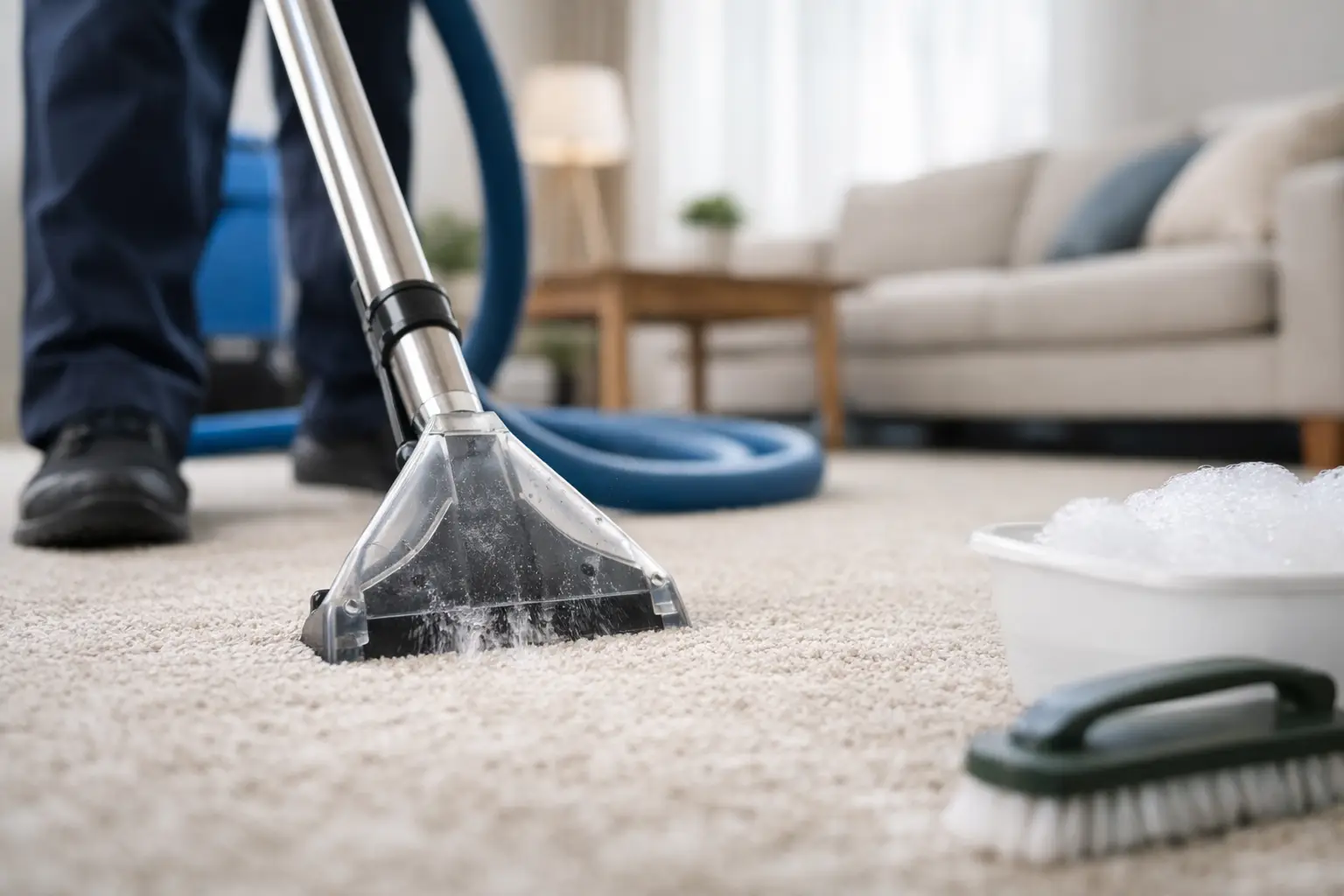
Almost every carpet cleaning company quotes a drying time of four to six hours. In much of the country that is honest. In Hampton Roads between June and September, it is a number that assumes conditions we do not have.
This is worth understanding rather than just tolerating, because most of what determines drying time is under your control — and the most common piece of advice people follow, opening the windows, actively makes it worse here.
Drying Is About the Air, Not the Carpet
Water leaves a carpet by evaporating into the air above it. That process only continues as long as the air can hold more moisture. Once the air immediately above the fiber is saturated, evaporation effectively stops until that air is replaced with drier air.
This is why relative humidity matters more than temperature. A warm room already full of moisture dries a carpet slowly. A cooler room with genuinely dry air dries it quickly. And it is why coastal Virginia is difficult: we sit between the Atlantic and the Chesapeake Bay in a humid subtropical climate, and outdoor dew points here regularly sit in the seventies through midsummer.
Which brings us to the windows. On a July afternoon in Virginia Beach, the air outside typically holds more moisture than the conditioned air inside. Opening a window in that situation does not ventilate the room — it imports humidity. The instinct is understandable and the result is a carpet that stays damp longer.
The Four Things That Actually Control Dry Time
Every drying situation comes down to the same four variables, and a good technician manages all of them rather than just the first.
| Factor | Why it matters | What to do about it |
|---|---|---|
| Moisture applied | Less water in means less water to remove | Correct solution rates and thorough extraction passes |
| Air movement | Replaces saturated air at the fiber surface | Fans aimed low across the carpet, not down at it |
| Humidity | Determines how much moisture the air can accept | Run the AC; close windows; a dehumidifier for problem rooms |
| Temperature | Warmer air holds more moisture | Do not overheat the room — pair moderate warmth with dehumidification |
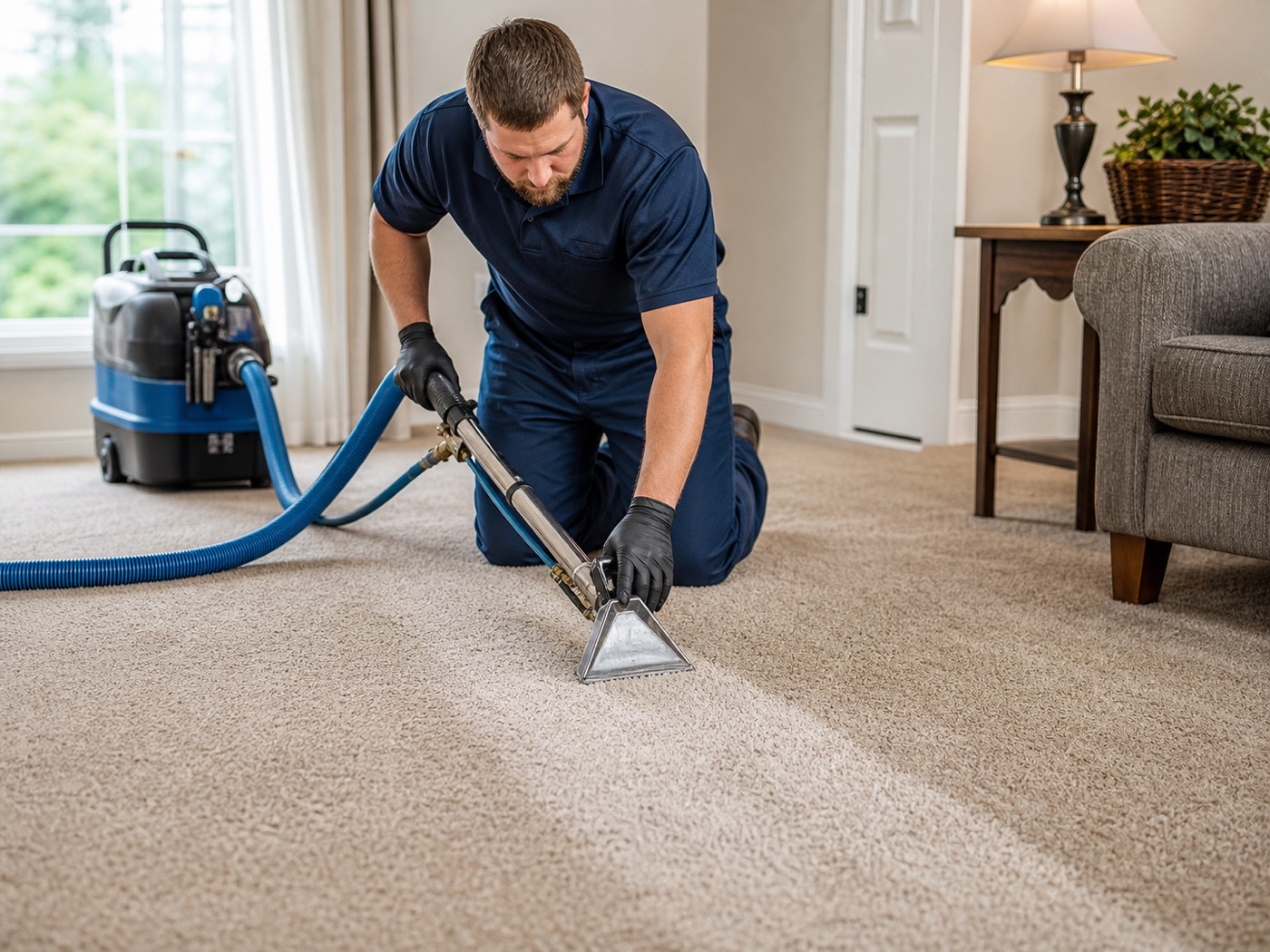
Notice that the first one is entirely on the cleaner. A carpet cleaned with excessive solution and a rushed extraction pass starts the drying process with far more water in it than necessary, and no amount of fan time fully compensates. The extraction step is where a careful hot water extraction job separates itself from a fast one.
What to Do in the Hours After Cleaning
- Close exterior windows and doors and set the air conditioning to a normal comfortable temperature — not warmer.
- Put fans at floor level, angled to blow across the carpet surface rather than straight down into it.
- Open interior doors so air can circulate between rooms instead of stalling in one.
- Keep foot traffic off the damp carpet. Walking on wet fiber pushes soil back into it and flattens the pile before it recovers.
- Leave furniture blocks or protective tabs in place until the carpet is genuinely dry, not just dry on top.
- If a room has poor airflow — an interior bedroom, a ground-floor room over a crawlspace — consider running a dehumidifier in it overnight.
Ceiling fans help, but not as much as people assume, because they move air downward from well above the floor. A box fan set on the ground and aimed across the room does considerably more work for drying purposes.
When a Lower-Moisture Method Makes More Sense
Hot water extraction is the most thorough process available for most carpet, and for a heavily soiled floor it is worth the drying time. But there are situations where the drying window is the binding constraint rather than the cleaning depth.
A commercial space that has to reopen in the morning, a short-term rental turning over the same afternoon, or a room that a household genuinely cannot vacate for a day are all reasonable cases for encapsulation or another low-moisture approach. These dry in an hour or two and improve appearance meaningfully. What they do not do is flush the base of the pile, which is why the sensible pattern is low-moisture maintenance between periodic deep extractions rather than one or the other forever.
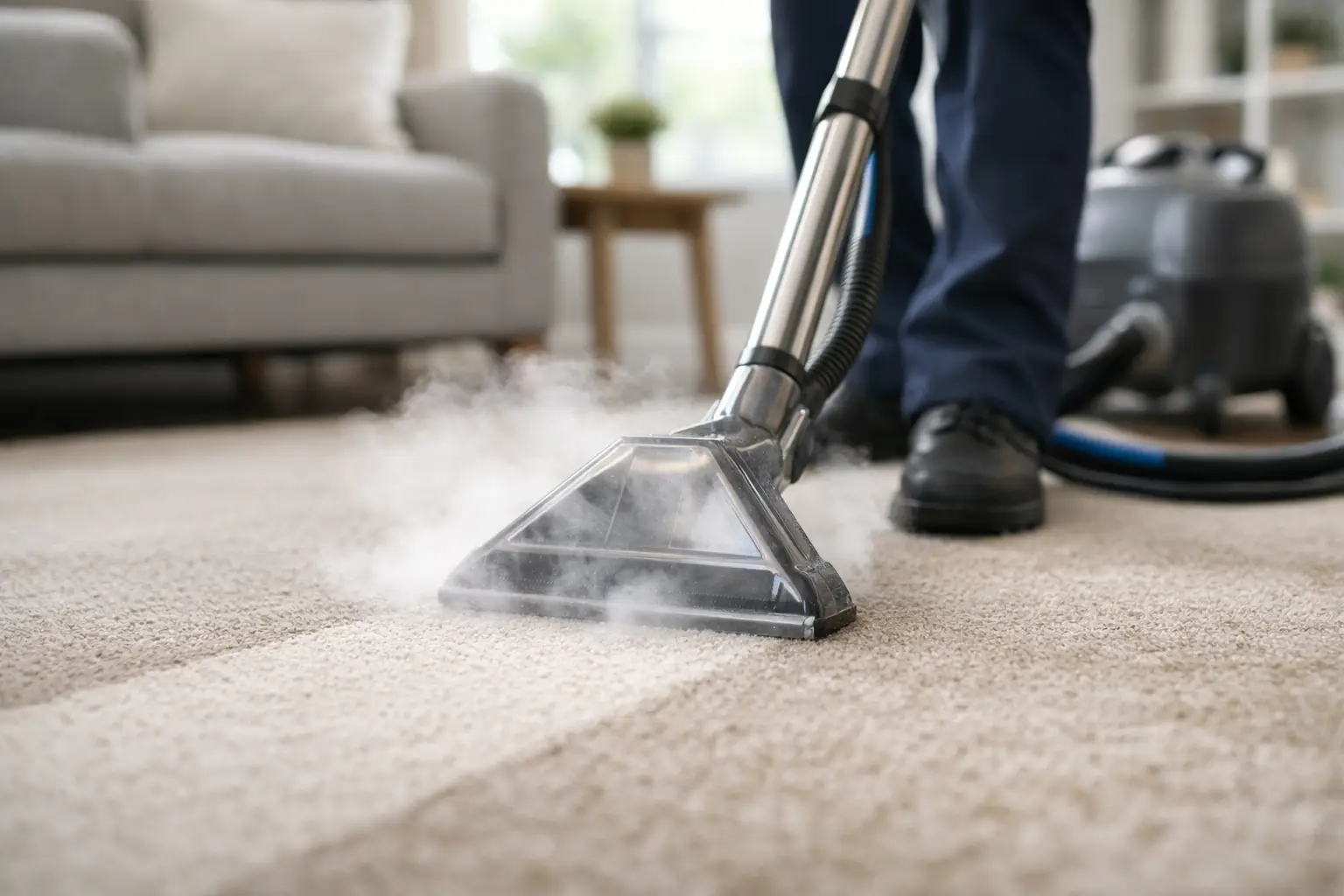
The trade-off is worth understanding before you decide, and it is the same trade-off that comes up whenever people ask whether steam cleaning is the right choice for a particular floor.
Upholstery Is the Slower Problem
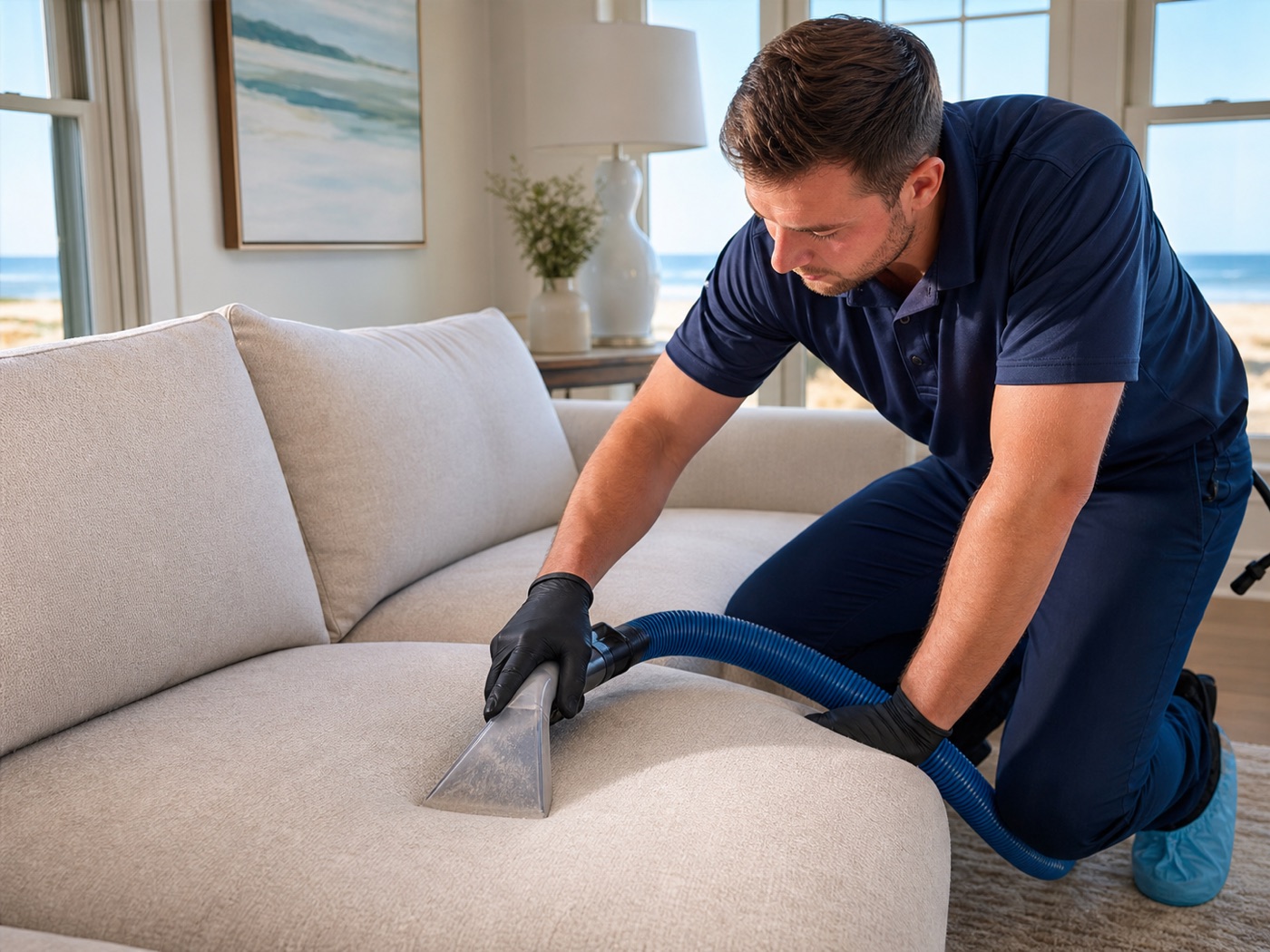
Carpet sits on a floor with air moving over one surface. A sofa cushion is a thick, dense block of foam and fiber wrapped in fabric, and moisture inside it has a much longer path out. In a humid house, a cushion cleaned with too much water can stay damp inside for a day or more even after the surface feels dry.
That is why fabric seating gets controlled hand-tool extraction rather than the same volume of water a floor gets, and why cushions are repositioned to expose more surface to air. It is also why a heavily fragranced product on damp upholstery is a bad idea in August — you are sealing a smell over a wet cushion rather than solving anything.
Why Fast Drying Protects the Cleaning Itself
Drying time is usually discussed as a convenience issue — when can we put the furniture back, when can the kids come in. It is also a quality issue, and that part gets less attention.
The first reason is wicking. When a carpet dries slowly, moisture moving upward through the fiber carries dissolved material with it. Anything that soaked into the backing or pad — an old spill, a pet incident, adhesive residue — can migrate back to the surface as the water evaporates and reappear as a spot two days after a cleaning that looked perfect. Faster drying gives that process less time to work.
The second is odor. Carpet, pad, and the dust and organic material in them stay biologically quiet when they are dry. A floor that stays damp for two days in an eighty-degree house is a different environment, and that is where a musty smell after cleaning comes from. It is almost never the cleaning product; it is the drying.
The third is resoiling. Damp fiber is soft and open, and grit walked into it while wet embeds far more readily than it would into a dry carpet. Keeping traffic off until the floor is genuinely dry is not fussiness — it is the difference between a cleaning that lasts six months and one that looks tired in six weeks. This is the same reasoning behind treating drying as part of the job rather than an afterthought in any deep clean.
When Slow Drying Is a Warning Sign
Most slow drying is environmental. Occasionally it points at something else. Carpet that stays damp in one specific area while the rest of the room dries normally can indicate a plumbing leak, a slab issue, or moisture coming up from a crawlspace. Carpet that dries but smells musty within days often means moisture is still arriving from underneath.
In those cases, cleaning the carpet again is not the answer — finding the water source is. A good cleaner should tell you that rather than sell you a second service. The same logic applies to residential floors generally: the visible problem and the actual cause are frequently in different places.
The Short Version
Carpet in Hampton Roads dries more slowly than the industry's standard estimate, and the fix is mostly mechanical: less water applied, thorough extraction, real air movement at floor level, and air conditioning rather than open windows. Do those four things and a summer cleaning behaves much closer to the four-to-eight-hour range people expect.
All City Carpet Cleaning And Building Solutions plans drying as part of the job rather than as an afterthought, across Virginia Beach, Norfolk, Chesapeake, Suffolk, and Portsmouth. If you need a room usable by a specific hour, say so when you book — that changes the method we recommend.