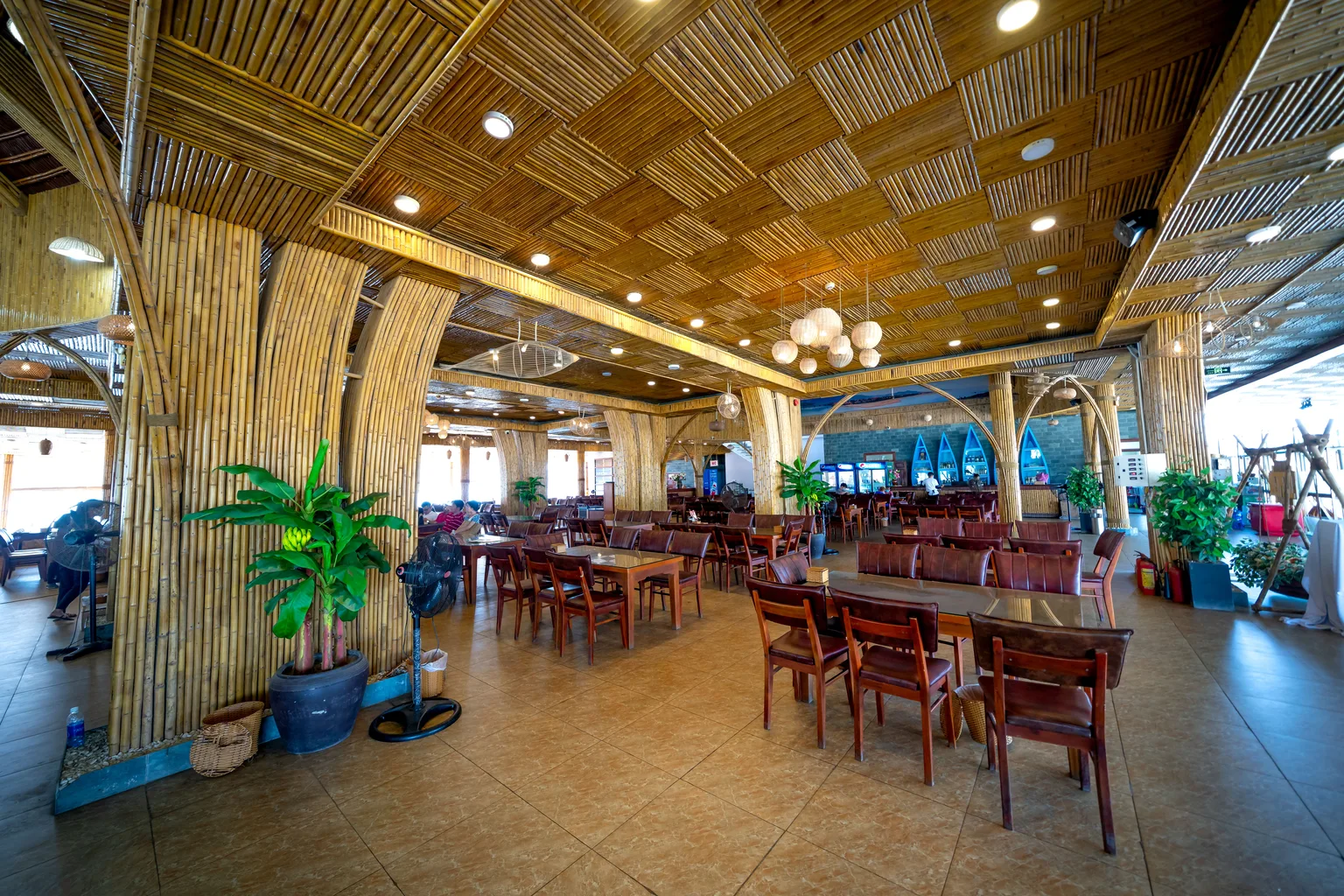
Restaurants across Hampton Roads — the Oceanfront, Ghent, Olde Towne, Town Center — deal with a floor-care problem most businesses do not. A single building contains three fundamentally different flooring situations, each failing in its own way, and each needing a method that would be wrong in the other two rooms.
Treating them as one recurring line item is how kitchens stay slick, grout goes permanently dark, and dining room carpet needs replacing years earlier than it should.
The Kitchen Floor Is a Grout Problem
Commercial kitchens are typically finished in quarry tile, which is a good choice: dense, durable, and manufactured with a textured surface that provides slip resistance when wet. The tile itself rarely fails.
What fails is the grout. Airborne cooking grease settles across the whole room, mixes with food debris and cleaning residue, and works into the joints. Those joints sit slightly below the tile face, so they collect everything, and they are the part of the floor doing the traction work. Once they fill in, the floor is functionally smooth even though the tile is not.
Nightly mopping does not reverse this, and often accelerates it. A mop moves through a bucket of water that gets greasier with every pass, and past a certain point it is applying a thin emulsified film rather than removing one. Using a general-purpose neutral cleaner on a grease load compounds it — the detergent lacks the alkalinity to break down fat, so the residue stays and builds.
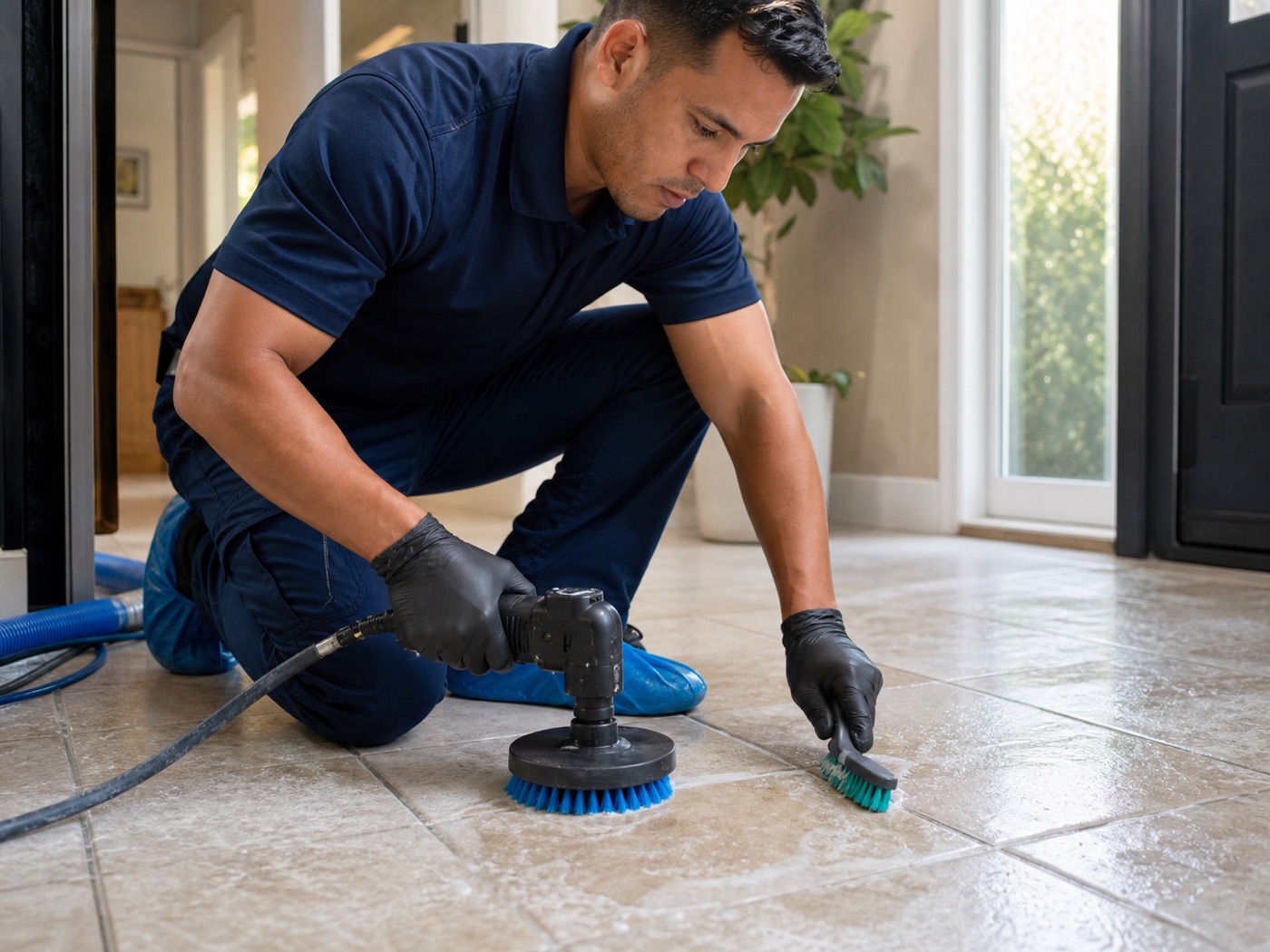
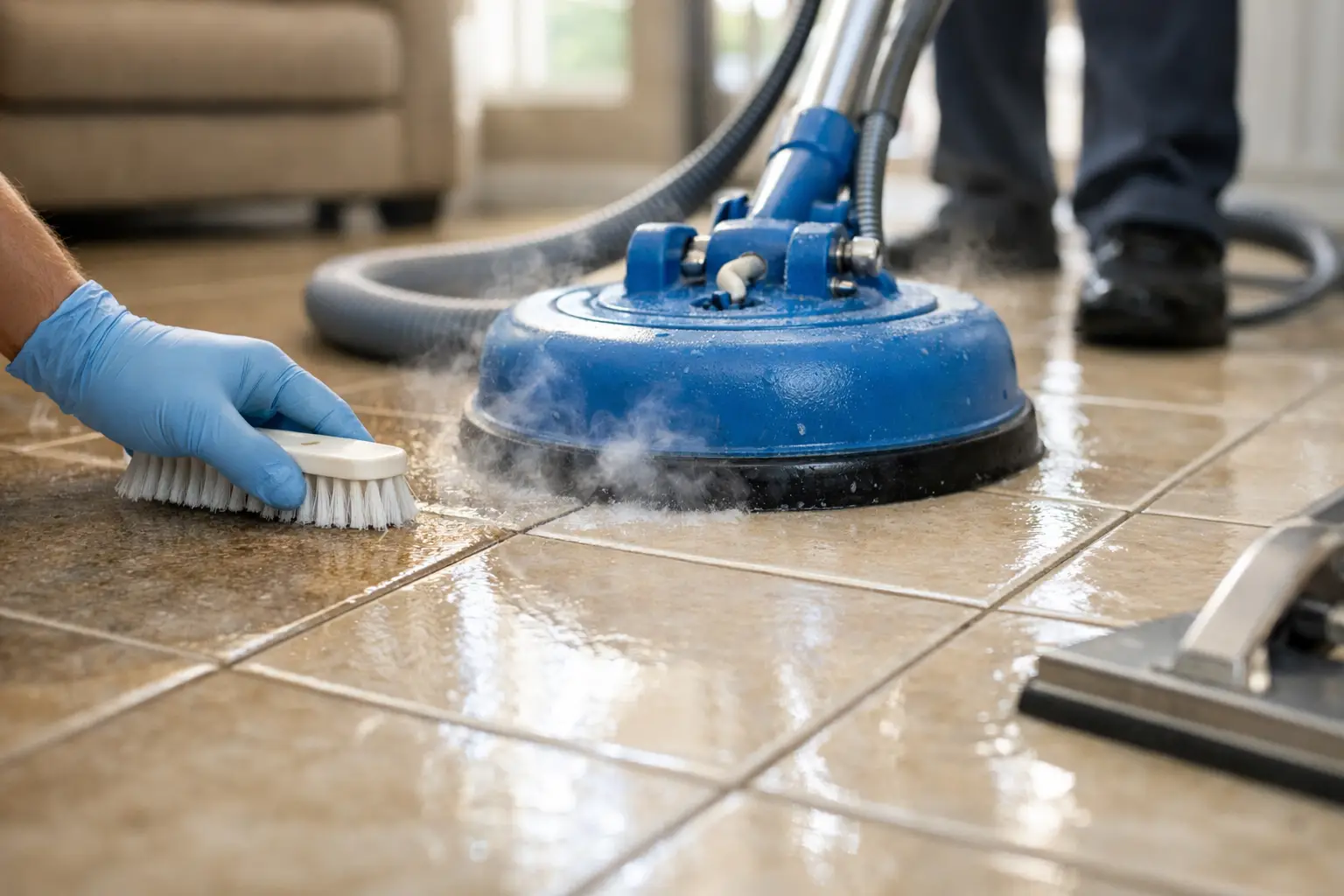
What resets a kitchen floor is mechanical agitation with appropriate degreasing chemistry, followed by recovery of the slurry rather than mopping it around. Done on a real interval, the traction comes back because the grout profile comes back. That is a different job from daily cleaning, and it is what deep tile and grout work is for.
Three Floors, Three Methods
| Area | Typical surface | The right approach |
|---|---|---|
| Kitchen and dish | Quarry tile with grout joints | Alkaline degreaser, mechanical agitation, slurry recovery |
| Service corridor and waitstation | Tile, VCT, or sealed concrete | Depends on finish — scrub and recoat if it is a waxed resilient floor |
| Dining room | Carpet, LVP, or wood | Extraction for carpet; never wax LVP or wood |
| Entry and vestibule | Tile or entry matting | Matting maintenance plus regular grout attention |
| Bar | Rubber mats over tile | Mats lifted and cleaned separately; the floor beneath is usually the worst in the building |
The bar row surprises people. Rubber fatigue mats get lifted and hosed, but the floor underneath them frequently goes months without real attention, and it collects a mix of sugar, citrus, alcohol, and grease that is corrosive to grout and unpleasant when it warms up.
Dining Room Carpet Wears in a Pattern
Restaurant carpet does not wear evenly, and knowing the pattern lets you spend maintenance money where it does something.
The heaviest wear is always the path from the kitchen door to the dining room, because servers walk it hundreds of times per shift carrying weight. Second is the entry and host stand. Third is the traffic aisle between table sections. The area under the tables themselves — which is where food actually lands — usually looks better than any of those, because nobody walks on it.
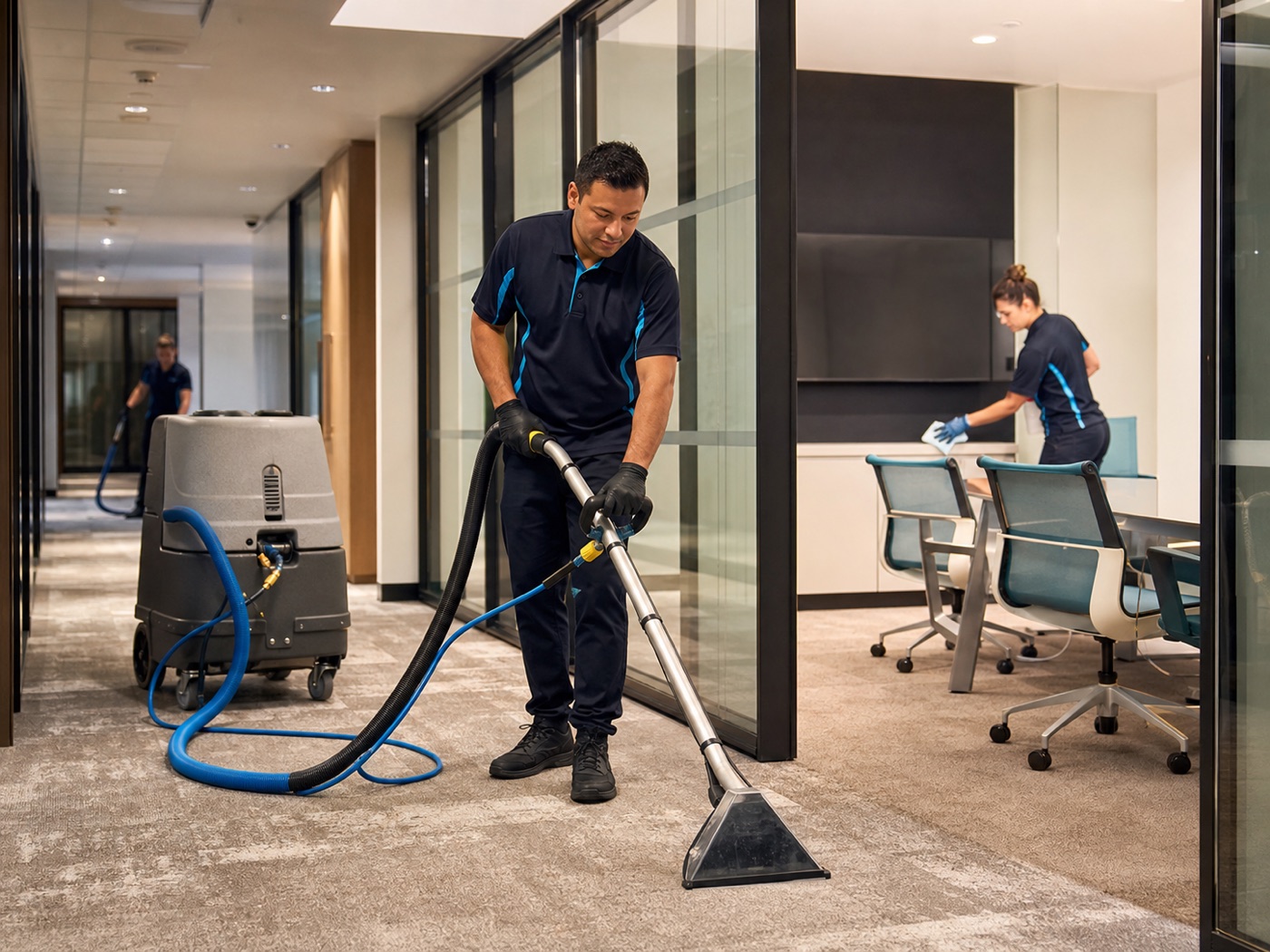
That means a maintenance program that treats the room uniformly is misallocating effort. Traffic-lane focused cleaning on a shorter interval, with full-room extraction less often, keeps a dining room looking considerably better for the same budget. Commercial carpet work is scheduled and scoped around exactly this kind of traffic mapping rather than square footage alone.
Spot response matters more here than almost anywhere. Red wine, tomato, coffee, and grease all behave differently, and a server armed with a spray bottle of the wrong product does more damage than the spill. It is worth a short staff briefing on blotting rather than rubbing, and on which spills to leave for professional treatment rather than attacking with whatever is behind the bar.
When Stripping and Waxing Is — and Is Not — the Answer
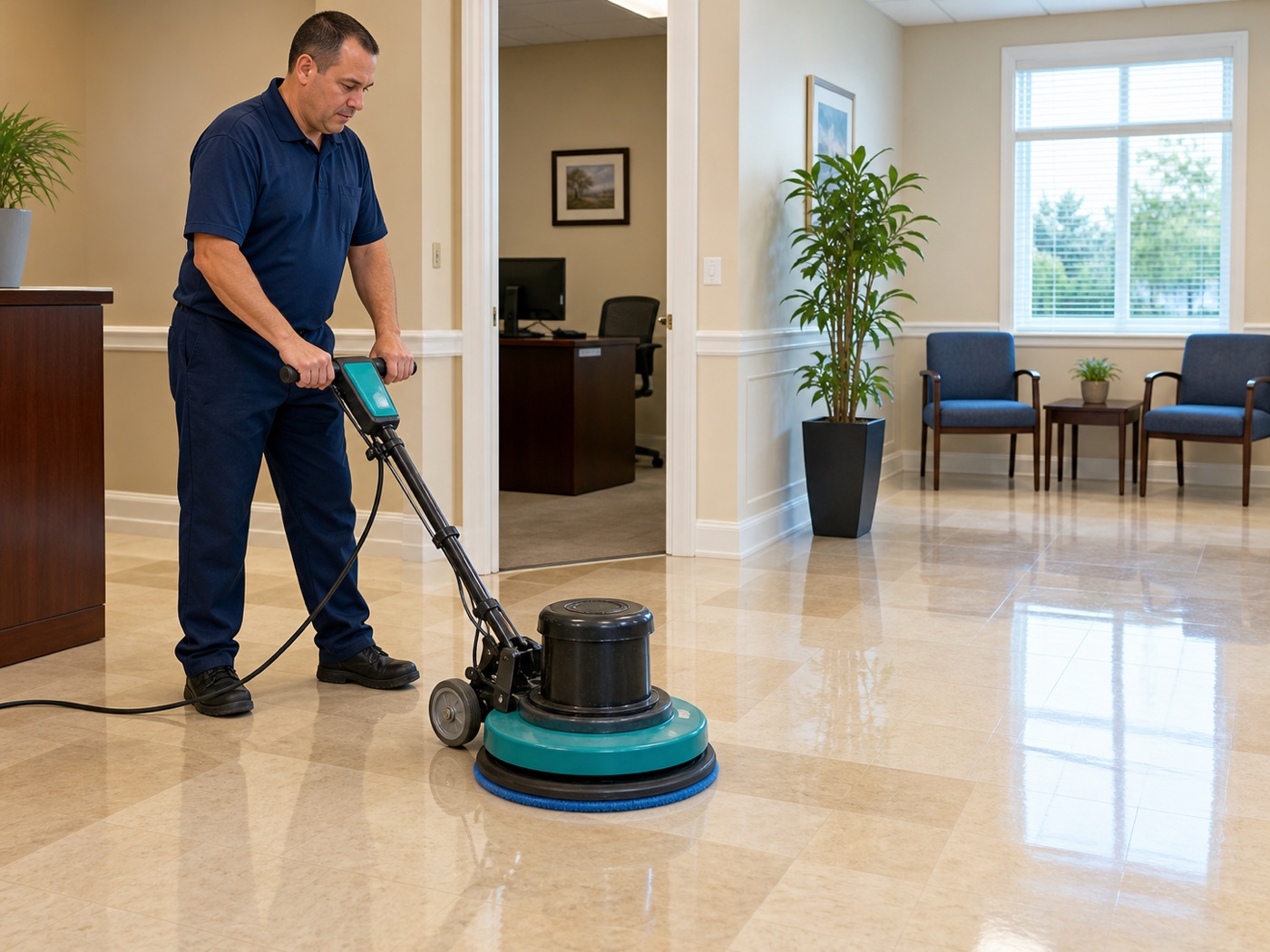
Plenty of restaurants have a resilient floor somewhere: a service corridor, a back office, a private dining room in an older building. Vinyl composition tile with a finish on it does need periodic stripping and recoating, because layered finish yellows, traps soil, and eventually looks worse than the bare floor would.
The failure mode is applying that process where it does not belong. Ceramic and porcelain tile, quarry tile, natural stone, hardwood, and most luxury vinyl plank should not be waxed. Finish on those surfaces creates a film that scuffs, peels, and holds soil, and removing it later is more work than the original mistake saved. Confirming the substrate before scoping a stripping and waxing job is not a formality.
Cure time is the other constraint. A freshly finished floor needs to be left alone, and that window has to fit between your last cover and your first prep shift. In practice, that usually means planning it around a scheduled closure rather than an ordinary overnight.
The Entry Decides How Much Work Everything Else Needs
Every particle of outdoor soil in a restaurant walked through the front door, and how much of it makes it past the vestibule is almost entirely a function of matting.
The rule of thumb in commercial facility maintenance is that it takes roughly fifteen feet of walk-off matting to remove the large majority of what a shoe carries. Most restaurants have three or four feet, which catches the obvious debris and passes everything finer straight into the dining room. In a coastal market that is a real problem, because the fine material here includes quartz sand that abrades carpet fiber rather than just dirtying it.
The practical version does not require fifteen feet of mat. A scraper mat outside, an absorbent mat inside, and a hard-surface vestibule floor that gets cleaned rather than just mopped will do most of the work. What matters is that the matting is long enough for several full steps and that it is actually maintained — a saturated mat is a soil reservoir, not a barrier.
The payoff shows up two rooms away. Entry control is the cheapest possible way to extend the life of dining room carpet, and it is the reason two restaurants with identical floors and identical cleaning schedules can be on completely different replacement timelines. The same principle governs floor care in office buildings, where entry matting is the single highest-return maintenance decision.
Scheduling in a Seasonal Market
Hampton Roads restaurants run on a seasonal curve, and Oceanfront operators especially. Volume climbs through spring, peaks from Memorial Day through Labor Day, and drops off in the fall — which is exactly the right time for the deeper work that is impossible to schedule in July.
A sensible annual rhythm looks like maintenance-level work through the busy season, then the heavy reset in the shoulder months: full kitchen grout deep clean, any strip and recoat, and full dining room extraction. Booking those windows in advance is worth doing, because every operator in the region reaches the same conclusion in September.
Coastal humidity is worth factoring in as well. Dry times run longer here than the equipment manufacturer's estimate suggests, and a dining room that is still damp at four o'clock is a problem for a five o'clock cover.
The Short Version
A restaurant floor plan should look like three plans. Kitchen tile needs periodic mechanical degreasing so the grout joints do their job. Dining room carpet needs traffic-lane attention more often than full extraction. Resilient floors need stripping and recoating, and everything else needs to be kept away from wax entirely.
All City Carpet Cleaning And Building Solutions works with restaurants and commercial properties across Virginia Beach, Norfolk, Chesapeake, and Portsmouth. Scope and scheduling get built around your service hours, because the alternative does not work for anybody.