
Households think carefully about carpet, occasionally about upholstery, and essentially never about the mattress — which is odd, because the mattress is the surface with the most direct human contact in the building. Eight hours a night, skin against fabric, for somewhere between eight and fifteen years.
In coastal Virginia it is also the surface most affected by our climate, for reasons that come down to humidity and what humidity allows to live.
What Is Actually in There
A mattress accumulates four things, and they interact.
The first is shed skin. A person sheds a meaningful quantity of skin cells daily and a large share of it lands in the bed. The second is moisture — the body releases water vapor throughout the night, and a portion of it goes into the mattress rather than the air. The third is body oil, which migrates through bedding into the surface fabric over months. The fourth is dust mites, which live on the first item and require the second.
Dust mites are the part that matters for health. They are microscopic, they are in essentially every home, and they are harmless in themselves. What triggers allergy and asthma symptoms is the protein in their waste, which becomes airborne when the bed is disturbed — which is to say every time someone rolls over.
They need humidity above roughly fifty percent to survive, because they absorb water from the air rather than drinking. In Phoenix they struggle. In Virginia Beach, where dew points stay elevated from May through September, they have most of a year of ideal conditions, and coastal households carry a heavier load than inland ones for that reason alone.
The Encasement Is the Answer
If you take one thing from this article, take this: a zippered allergen-barrier encasement does more for a dust mite problem than any cleaning, and it keeps doing it.
An encasement is a fabric cover with a pore size small enough to block mite allergen, zipped fully around the mattress. It accomplishes two things at once. It stops new skin cells from reaching the mattress, which starves whatever population is already in there. And it puts a barrier between the existing allergen and the person sleeping on it.
Modern encasements are not the crinkly plastic sheets people remember. Good ones are breathable fabric and are indistinguishable from a mattress protector once the bed is made. They cost less than a single professional cleaning and they work continuously rather than for a few months.
Do the pillows at the same time. Pillows are in the closest contact with a sleeper's face of anything in the room, they hold moisture directly from breathing, and they are cheap enough to encase or replace outright.
Humidity Is the Second Lever
The humidity point is the one Hampton Roads households underuse, and it has effects well beyond the bedroom.
Below about fifty percent relative humidity, dust mite populations decline because they cannot maintain their water balance. Above it they thrive. Our summers sit well above that line outdoors, and indoor humidity follows unless something is actively pulling it down.
Air conditioning dehumidifies as a side effect of cooling, which is why summer indoor humidity is usually manageable in a well-running house. The problem months are the shoulder seasons — spring and fall, when it is mild enough that the air conditioning barely runs but humid enough that the air is holding a great deal of water. A standalone dehumidifier in a bedroom during those stretches is inexpensive and noticeably effective.
A cheap hygrometer tells you where you actually stand, and most households are surprised. Measuring first is better than guessing, because the fix depends entirely on the number.
The Weekly Routine
The maintenance side is unglamorous and it is where most of the benefit actually lives.
- Wash sheets and pillowcases weekly in hot water. Temperature is the active ingredient — a warm wash removes soil but does not reduce mite populations.
- Vacuum the mattress surface monthly with an upholstery tool, slowly, and do the seams and the edge piping where material collects.
- Pull the covers back for half an hour after getting up rather than making the bed immediately. It lets overnight moisture escape instead of trapping it.
- Rotate the mattress on the manufacturer's schedule, which also gives you a reason to look at the underside twice a year.
- Keep a hygrometer in the bedroom and act on what it says rather than on how the room feels.
- Replace pillows every year or two. They absorb more than anything else in the bed and they cost very little to renew.
The unmade-bed point is the one people enjoy most, and it is real. A bed made immediately traps the moisture released overnight against the mattress, which is precisely the condition dust mites need. Half an hour of air does more than it sounds like it should.
When Cleaning Genuinely Helps
Having argued that encasement beats cleaning, there are real cases where cleaning is the right call, and we would rather name them precisely than sell it broadly.
A spill or an accident is the clearest one. Urine, vomit, or blood that has soaked in needs proper treatment, and a mattress that has taken an accident and been surface-wiped will develop odor as the material breaks down. This is common with children and it is worth handling promptly rather than layering a protector over it.
A used or stored mattress is the second. Anything that has been in a garage, a storage unit, or a previous household through a Hampton Roads summer has taken on humidity and whatever came with it, and cleaning before it goes into service is reasonable.
Heavy sweat staining is the third. Those yellow-brown areas are body fluid oxidized into the fabric, and beyond appearance they represent organic material sitting in the surface people breathe against. And the fourth is an existing allergen load in a household with a diagnosed sensitivity — reducing what is already there before encasing makes practical sense.
How It Has to Be Done
Mattress cleaning has one hard constraint that makes it different from carpet or upholstery work: a mattress cannot be extracted through, and it cannot be dried from below.
Carpet sits on a pad over a subfloor, and air can be moved across it. A mattress is a thick foam or spring core wrapped in fabric, and any water that reaches the core stays there. A mattress that has been over-wetted is genuinely at risk of mildew inside it, which is not recoverable and is considerably worse than whatever the cleaning was meant to address.
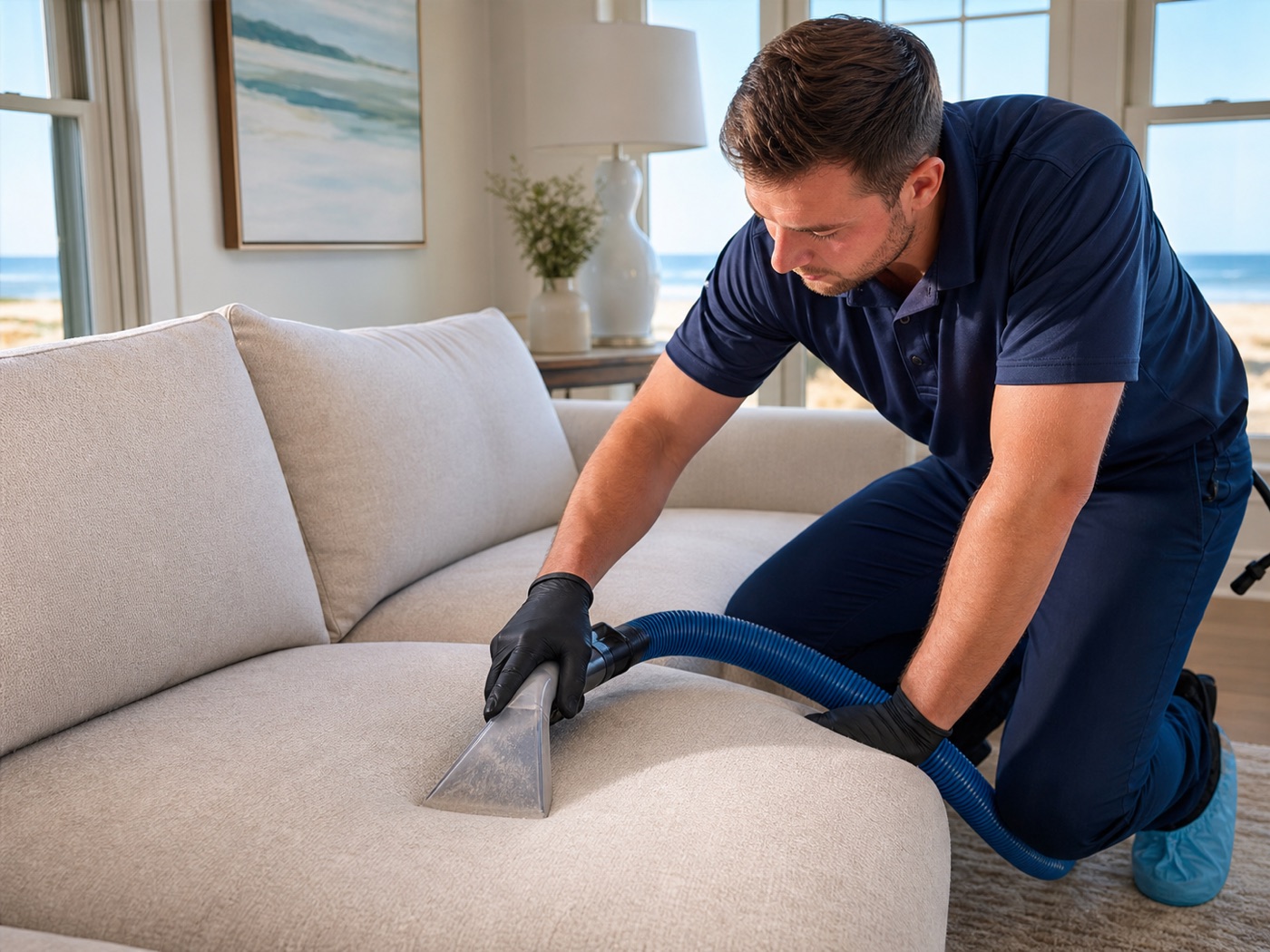
So the process is deliberately conservative: thorough dry soil removal first, targeted treatment of specific spots rather than the whole surface, low-moisture extraction with strong vacuum recovery, and air movement afterward until the surface is fully dry. Anyone proposing to saturate a mattress is proposing to damage it.
The same restraint applies to the box spring and to any upholstered headboard, both of which collect the same material and neither of which anybody ever thinks to clean.
The Rest of the Bedroom
A mattress does not sit in isolation, and treating it alone usually disappoints in an allergy household.
The bedroom carpet is the largest reservoir in the room and holds settled allergen that gets stirred up every time someone walks across it. Cleaning it on a six-month interval in a sensitive household does more measurable good than most of what gets sold for allergies, because it empties the filter rather than covering it.
Curtains, upholstered chairs, and anything soft in the room belong in the same accounting. So do the HVAC filters, which in this climate should be changed on schedule rather than when someone remembers.
None of this is exotic. It is a barrier, a hygrometer, a weekly wash cycle, and a cleaning interval that reflects the household rather than a rule of thumb. The households that do all four consistently report the biggest difference, and the ones chasing sprays and wands generally do not.
All City Carpet Cleaning And Building Solutions handles mattresses, upholstery, and carpet across Virginia Beach, Norfolk, Chesapeake, Suffolk, Hampton, Portsmouth, and Smithfield, with area pricing published up front.